Saturday, June 8, 2013

It's Perfectly Safe - See?

Just like other Fellows that will be going on the trip, many colleagues' eyes widened when I said Korea.  They were aware of the rockets and nuclear bomb tests, and the increasing drumbeats of, if not war, then at least heightened tensions on the peninsula.  But yesterday good news broke out, instead of war!
The two Koreas have agreed to talks on several issues, including reopening the factories at Kaesong, inside North Korea.  All of the (formerly) increasingly angry and defiant bluster from Kim Jong-un was just that - talk.  Most of it seemed designed for internal consumption - See?  I can stand up to evil America! - to consolidate the new leader's shaky grip on power.
Kaesong is a complex of factories where 123 South Korean companies employ 53,000 North Korean workers.  Their wages are paid directly to the DPRK government, and are its main source of foreign currency.  When the new leader came to power, and North Korea ratcheted up the tension between the 2 countries, the complex was shut down by DPRK in April.  Now that the government needs money, and apparently Mr. Kim has consolidated his power, there will be talks to reopen the factories.
Where will these talks be held?  Pan Mun Jom, of course!

Pyongyang unexpectedly offered Thursday to discuss the possible re-opening of the Kaesong industrial complex, a jointly run factory north of the border that was shuttered in April amid heightened tensions. It also proposed discussing the resumption of cross-border tours to the North's Mount Kumgang resort. South Korea halted visits there after the 2008 shooting death of a South Korean tourist by the North's troops. (VOA)
So don't worry, South Korea is a safe place to be.  And it just got better.

Friday, June 7, 2013

Oh The Places You'll Go!

On my last (and only) trip to South Korea I did not have the opportunity to visit any of the southern portion of the Korean peninsula.  We stayed in Seoul except for a one day trip to the DMZ and Pan Mun Jom.  This time I am looking forward to seeing much more of the country.  The following are a few of the sights I hope to see.
 The Janggyeong Panjeon in the Temple of Haeinsa
The temple complex here, on Mount Gaya, is home to the Tripitaka Koreana.  The Tripitaka are 80, 000 woodblocks carved in the early 13th century.  They contain the most complete collection of Buddhist texts, laws, and treaties that exist. 
The Haeinsa Tripitaka woodblocks were carved in an appeal to the authority of the Buddha in the defense of Korea against the Mongol invasions. They are recognized by Buddhist scholars around the world for their outstanding accuracy and superior quality.
UNESCO
The buildings which house these engravings were built in the 15th century.  The construction is such that a constant temperature and humidity is maintained, and the carvings are safe from rodent and insect damage.  For over 500 years the monks of the Jogye Order have cared for and protected these national treasures.  The site was designated as a UNESCO World Heritage site in 1995.  

We’ll also be going to Yangdong village, another UNESCO site.  This Joseon dynasty village was founded in the 14th-15th century.  The Neo-Confucianism of the Joseon dynasty is reflected in the siting, layout, and architecture of the buildings. 

The village is a clan village, which

developed and flourished in the Joseon dynasty which consolidated its absolute rule over Korea, encouraged the adoption of Confucian ideals in Korean society, (which had been introduced to Korean Peninsula in the first century), absorbed Chinese culture, and, through prosperity founded on trade, fostered classical Korean culture, science, literature, and technology.

             UNESCO

Pungsu, or geomancy, is evident in the layout of the village.  The Wind-Water-Earth Principles theory was first developed in Korea in the late 900s by Doseon-guksa, a Buddhist master in the Seon, or Zen, tradition. 

Pungsu-jiri-seol can be defined as the Korean style of divination performed according to topography, or as a Korean theoretical system that evaluates various features of land, mountain, and water, and then connects them to human fortune / misfortune, peace / calamity, and advancement / decline.


This ancient system is connected to the old mountain gods of Korea.  Emphasis is placed on the spiritual and material energies of mountains and their effects on the destiny of families, communities, and nations.

Four Goryeo-Dynasty Confucian scholars of the 12th Century (an era when concern over and speculation about the national identity was very popular), led by Kim In-jon and Bak Seung-jung, wrote a book entitled "Haedong-Pirok" [Secret History of Korea] that repeated and extended Doseon's theories, and that remains the oldest Pungsu-jiri text we now have.  In the middle of the Joseon Dynasty, scholar Yi Jung-hwan (1690-1752) surveyed the entire peninsula in both geographic and geomantic terms, and then wrote Taengni-chi, a book giving advice on the best places to live -- both social morality and the Pungsu-jiri ideas were clearly central to his Neo-Confucianist judgments.


Gi (Chinese Chi), or life force, is said to emanate from the mountain range which forms the backbone of the Korean peninsula.  It is very important, therefore, to help this force flow properly through citizens and the country. 


Another important place we will visit is Pan Mun Jom.  I was there on my first visit in 2009, and I am looking forward to returning.  This is the site of the armistice signing that ended the fighting in the Korean conflict.  A peace treaty has never been signed. 


The small building on the left was where the armistice was signed.  The large building in the background is in North Korea.
The scary-looking soldier came out and stood on the covered porch as we climbed the observation tower.

I known there are many more places I will see during my fellowship.  I intend to take numerous pictures, and write about as many as I can.  It's a beautiful country, and I want to share it with you.

Wednesday, June 5, 2013

Silla and the Silk Road


Silla and the Silk Road: readings from the Korea Society website.

Modern Korea is a mix of many influences.  Many of the ideas that contributed to modern Korea arrived via the trade route known as the “Silk Road.”  Silk, writing characters, architecture, Buddhism, and Confucian ideology all arrived on the peninsula which anchored the eastern end of a trade route that covered the entirety of Asia, and parts of Africa and Europe.  Korea eagerly adopted the new ideas, creating a vibrant and rich culture of their own.  In turn, Korea passed these innovations along to the island nation of Japan.


In 668 CE the Silla Kingdom, one of 3 on the peninsula, united Korea and ushered in what has come to be called the Golden Age of Korea.  This kingdom maintained ties with both China and Japan.  By doing so the kingdom accrued many benefits from the Silk Road trade.  These advances can be divided into two categories – religious and social ideas, and trade goods and technology.


By far the most important influence from Asia was Buddhism.  Brought to Korea in 372 CE by the Chinese, this religion is still a major force in Korean society.  In early times Koreans, like many other groups, practiced shamanism.  Local practices blended easily with the new religion, and many temples and shrines were built on hilltops, home of the shamanistic Mountain gods.  Buddhism remained the dominant influence until the rise of the Joseon dynasty in the 1300s.  It was repressed until the late 16th century, when Buddhist monks helped repel a Japanese invasion.

Blending of local customs and a new religion – the Last Supper with a Peruvian specialty –viscacha, 
Cuzco Cathedral, Peru


When Buddhism arrived in Korea, the society practiced a social order known as Bone-rank.  This ranking was predetermined by birth, and had rigid rules regarding social interactions.  With its belief that all people had an equal chance to reach Nirvana, Buddhism changed all of that.  Women’s rights expanded, and several important rulers during this time were women.  The rigid social system was also challenged by Buddhist teachings.


Confucian teachings were also known in Korea, and competed with Buddhism for the loyalty of scholars.  However, it remained in the shadow of Buddhism for many years.  Buddhist monasteries gained land and riches, and enjoyed many privileges.  By the 10th century there were civil service exams for government positions, but monks competed with Confucian scholars during the examinations.  


By the end of the Goryeo dynasty in 1392 the lower classes were pushing for land reform, and the Buddhist monasteries lost power to the Neo-Confucianists.  This group blended Confucian teachings with Taoism and Buddhism.  They emphasized ethics and the moral authority of the government.  The new rulers implemented land reform and redistribution of wealth, and criticized the excesses of the Buddhist clergy.  They also restricted the rights of women.  Buddhists lost power, and remained inconsequential for many years.


Trade goods and technology also traveled the Silk Road to Korea.  Of course, one of the first things they acquired was silk, and silkworms.  Silk was used as a sacrifice for the gods, as gifts for royalty, and as payment for services.  High-ranking Korean ladies introduced silkworm production to Japan in the 300s CE.  Iron-working techniques, court titles, and field measurement systems all entered Korea and then traveled to Japan.  The Chinese writing characters were adopted by the Koreans (Hanja), and used until the Joseon dynasty when they were replaced by Hangul.  Other technologies that were introduced into Korea included canal- and pond-digging techniques, law codes, and types of stoneware.
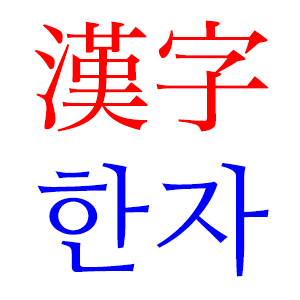
The Korean word Hanja (Chinese script) in Hanja (red) and Hangeul (blue).


 Cultural diffusion and trade both helped and hurt Korea.  New technologies and trade allowed easier lives, especially for the upper classes.  But the increasing concentration of wealth among the rulers left the peasants hungry and upset.  The Confucian ideals that eventually overtook Buddhism lowered the status of women, and they were at the mercy of their parents and husbands.  However, Korea did prosper, and the inflow of new ideas gave life to amazing art and architecture. 


Monday, June 3, 2013

Korea Fellowship

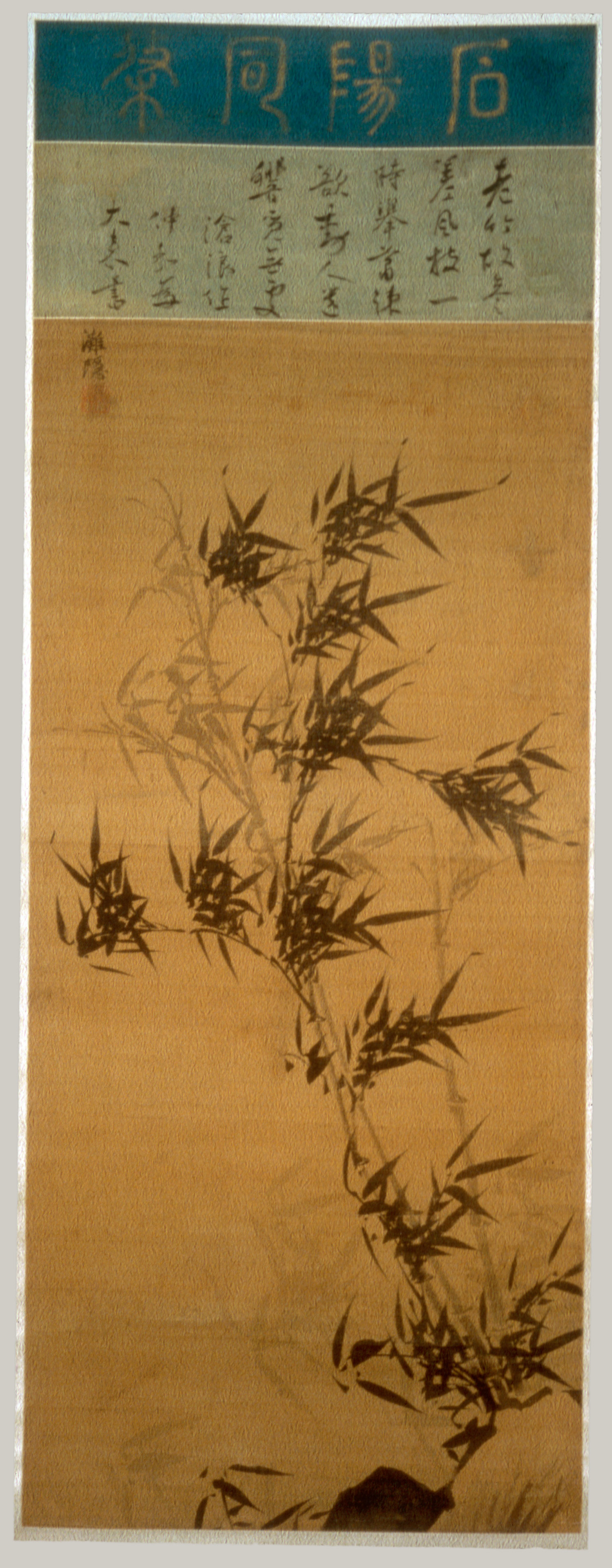
Ink Bamboo, Joseon dynasty (1392–1910)
Yi Jeong (Korean, 1541–1622)
Hanging scroll; ink on silk; 115.6 x 53.3 cm
Mary and Jackson Burke Foundation


I’ve been awarded a Fellowship by the Korea Society, and as part of the preparation for the trip I have to do some reading and writing.  I also watched some videos, mainly on Korean art and Confucianism.  So as reflection on the learning, I thought it might help me to blog about it, in order to clarify and summarize my thoughts on what I’ve learned.
The first piece I watched was a video on Choson (Joseon) art from the Korea Society website.  Dr. Kumja Paik Kim, Curator Emerita of Korean Art at the Asian Art Museum of San Francisco, spoke about Confucian influence on Choson dynasty art.  Because I knew next to nothing about Confucianism, I learned a great deal:
  • There are 3 bonds
    • Ruler/subject
    • Father/son        
    • Husband/wife
  • And 5 relationships ( Oryun)
    • Morally right – ruler/subject
    • Affection – father/son
    • Distinction – husband/wife
    • Order – elder/younger
    • Trust – friend/friend

These are important foundations of Confucian philosophy.  The Choson painters reflected these ideals in their paintings, using 4 plants and their symbolism:
  • Plum blossoms – because they grow on seemingly dead branches while its still cold, they symbolize perseverance, courage, trust, and hope
  • Orchids – grow in rocky places in the mountains, and represent modesty, refinement, and courage in the face of difficulties
  • Chrysanthemum blossoms – symbolize a life of retirement from political intrigue, simple living
  • Bamboo – because it is green throughout the winter, is stands for strength and courage – it bends but does not break, it is constant and tolerant
Munja-do  is the painting of 8 characters on 8 panel screens to represent  
  1. Filial piety
  2. Brotherly love
  3. Loyalty
  4. Trust
  5. Propriety
  6. Righteousness/justice
  7. Modesty/integrity
  8. Sensitivity/or feeling shame
Other facts about the art:  there is no use of "Western" perspective to show depth of field in paintings until the 1700s; the king was never depicted, but rather represented by his throne and screen.  The screen is behind his throne and has the sun, moon, and 5 mountain peaks.
 The throne is in Gyeongbokgung Palace in Seoul, South Korea.  I took this picture in 2009, and I am really excited to be returning this summer.

Tuesday, March 12, 2013

To Cuzco


Day 3, to Cuzco
I have not had much sleep – my roommate M___  is sick with some stomach bug, and has been up and down all night. I grab a bite to eat at the hotel breakfast buffet – fresh fruit, rolls, juice.  The coffee is terrible.  They have ham and cheese, some sort of cereals, but I pass on those.  Our group meets downstairs, and we drive to the airport. 
Through domestic security, then downstairs to wait.  This is the waiting spot for the planes where you get in a little bus and they drive you to the plane, and you walk up the stairs to board.  We have an hour-plus wait, so we watch people.  But first we look for my sick roommate.  No one has seen her since we went through security.  We check all the bathrooms, wander around a little upstairs, then more downstairs.  I find her in the front row of the waiting place, doubled over in the seat and resting.  She is not visible from anywhere in the room.  We are all happy to see her – she has not been lost, she knew where she was.
There are Earthquake security zone signs on the giant supports in the airport waiting room – will one hit while we are here?
They announce our flight, we line up, walk outside, and the smell hits us – the worst sort of death smell you can image.  Obviously there are many dead and rotting animals close by.  We all start to gag it is so overwhelming.  I feel really sorry for M__.  Short drive to the plane, more horrendous odor, then we are boarded, and don’t wait long to take off (thank goodness).  The flight is not bad, except for the landing.  Cuzco is in a small valley, so we have to drop down in a tight turn to land on the one runway.  I keep telling myself the pilot is experienced, he has done this before.  We make it.
Out into the sunshine, thin air, hawkers, vendors, ads for Coca Cola and Internet.  The bus arrives and we drive into town to our hotel.  We check in, meet with the group, then  Arturo our guide leads us to Jack’s, where we have to wait outside – it is packed.  Food was worth the wait – sandwiches, burgers, fries, beer.  Afterwards we wander around town for 4 hours, shopping, taking pictures, trying to cope with the altitude. Back to the hotel for dinner and an early evening.

Day 2, Lima

Day 2, in Lima
We are here on an “extra” day, and there is a sight-seeing tour in the afternoon. In the morning a group meeting, then a little walking around the area on our own. I go with some folks to the nearby mall. It’s very upscale, with views of the Pacific Ocean, although this morning it’s hard to see as it is very foggy. The cold Humboldt Current sweeps up the west coast of South America, and when the warm air hits it – fog. We wander through a small park, and buy water at a small store. Then back to the hotel. We go out again, back to the mall, for lunch. There is a typical food court there, but open air, overlooking the ocean. The fog has burned off, and what a view. I eat a sandwich with Asado de Res. It’s good.
Back to the hotel – its time for the city tour. There are not many really old buildings in Lima, because of the earthquakes, especially the one in 1746, which leveled everything that was here. It was a long time before it was rebuilt. Originally the Inca and rich Spaniards live further upriver from the coast, and farmed this land. Because the city is a desert, they used the water from the 3 rivers to irrigate their fields. Over time the city moved towards the coast.
The architecture of many buildings is Moorish/European, and its especially noticeable in the monastery. Of course I couldn’t take pictures there…. We did a lot of walking around town, and then headed back to the hotel, cleaned up, and walked to dinner. I had scallops, salad and a potato dish. The scallops were delicious, the salad great, and the potato pasta ok. Being on the coast Lima is famous for ceviche and other seafood. I didn’t eat any ceviche, but it looked yummy. Walk back to the hotel and crash. We fly out early in the am.

Professional Development

Day 1, we fly to Lima
I am riding to Houston with 3 women whom I don’t know very well. Over the course of the 3 hour car ride that changes, as we talk about whatever comes to mind – teaching, husbands/men, traveling – but not necessarily in that order. More of the group meets us at the airport, we eat some lunch, wait some more, and finally board the plane.
We are scheduled to depart at 3:55. We take off at 5:10. Apparently there is trouble with passengers. Two men sit in business class but they have economy tickets. They refuse to move, so they and then their luggage are removed from the plane. Then there is a woman and her 12ish year old son who want to sit in the emergency exit row because there is more leg room. He is too young to sit there, their tickets sit them elsewhere, and finally after they are threatened with removal they go back to their original seats. And we take off.
After 6+ uneventful hours of flying, in which I can’t see anything out the window because I am in the middle (albeit on the aisle), we land in Lima, Peru. The bus meets us, it’s hot and humid – like Houston – outside, and we drive 40 minutes to Miraflores, one of the rich areas. Our hotel is not a rich one, but it has a bathroom with a toilet (you still have to put the paper in the trashcan) and Internet. We sleep.

Monday, March 12, 2012

Rainy Weather

Visiting Seattle during the winter is not for the outdoorsy. We have been here a couple days and have had rain, brief sunshine, and snow.
Today we're in Bremerton running errands. We went from snow in Seabeck on the Hood Canal to rain on the Puget Sound side of the Kitsap peninsula.
Such a short distance yet way different weather due to the water and topography.